
'Periods of high volatility are usually bad for mid-caps and this is something that has to be kept in mind.' 'Focus on quality is of paramount importance.'

The southwest monsoon has started on a weak note and this has delayed the sowing of kharif crops. Though a cause for concern, the situation hasn't reached a stage where it warrants any panic response. Moreover, according to meteorologists and industry players, monsoon rains will witness a revival in the coming few weeks.

'In the overall global portfolio, India's weighting has come down in the past seven months.'

The markets may be entering a consolidation phase and are expected to trade sideways for now after a good run in the last few weeks, suggest analysts. In this backdrop, they suggest investors can book profits at the current levels and enter the market again on a decline from a medium-to-long term perspective. Thus far in fiscal 2023-24 (FY24), the S&P BSE Sensex has moved up around 5 per cent to nearly 62,000 levels.

From the Sensex pack, State Bank of India, Axis Bank, IndusInd Bank, Tech Mahindra, HCL Technologies, Tata Consultancy Services, Maruti Suzuki, Tata Steel and Tata Motors were the major gainers. Power Grid and HDFC Bank were the laggards from the pack.

Benchmark equity indices Sensex and Nifty rose by nearly 1 per cent on Friday, extending gains for a second day on the back of buying in banking, financials and energy stocks in line with firm global trends. The 30-share BSE Sensex advanced further by 462.26 points or 0.88 per cent to settle at 52,727.98. During the day, it rallied 644.15 points or 1.23 per cent to 52,909.87. The Nifty gained 142.60 points or 0.92 per cent to settle at 15,699.25.

Retail inflation declined to an 18-month low of 4.7 per cent in April mainly due to falling prices of vegetables, oils and fats, and came closer to Reserve Bank's target of 4 per cent, showed government data released Friday. It was for the second month in a row that Consumer Price Index (CPI) based inflation remained within the RBI's comfort zone of below 6 per cent. The government has tasked the central bank to ensure retail inflation remains at 4 per cent with a margin of 2 per cent on either side.

The market capitalisation of BSE-listed firms reached an all-time high of Rs 288.50 lakh crore on Wednesday amid an ongoing rally in equities, as the benchmark Sensex settled above 63,000-level for the first time ever. The 30-share BSE barometer climbed 417.81 points or 0.67 per cent to settle at 63,099.65, its fresh record closing high. During the day, the benchmark jumped 621.17 points or 0.99 per cent to 63,303.01, its lifetime intra-day peak. Extending its winning momentum to seventh day, the Sensex has rallied 1,954.81 points or 3.19 per cent during this time.

A sharp rally in domestic stocks from June lows has once again rendered Indian markets expensive to their emerging-market (EM) peers. The 12-month forward price-to-earnings (P/E) multiple for the Nifty50 Index is around 20.6x - 82 per cent higher than 11.3 per cent for the MSCI EM Index. India's valuation premium has hit a five-month high. This is on the back of sharp outperformance to EM and global peers from June lows and also due to earnings downgrades, following the April-June quarter of 2022-23 earnings.
The Sensex finished above the psychologically key 60,000-mark while the Nifty surged past the 18,000-level on Monday on across-the-board buying amid a mixed trend overseas. A depreciating rupee and concerns over the US Federal Reserve hiking rates later this week failed to quell investors' appetite for stocks, traders said. The 30-share BSE Sensex rallied 786.74 points or 1.31 per cent to settle at 60,746.59.

The rupee on Thursday closed at its all-time low of 78.32 (provisional) against the US dollar as strong American currency and persistent foreign fund outflows weighed on investor sentiments. At the interbank foreign exchange market, the local currency opened at 78.26 and finally settled at its all-time low 78.32, unchanged from its previous close. On Wednesday, the rupee declined by 19 paise to settle at an all-time low level of 78.32 against the US dollar.

Both players have been timed among the fastest in the game, with top speeds of around 36.5kpm (22.6 mph), but it is how quickly they get there that makes them different.

The veteran politician accused the BJP of breaking duly elected governments in opposition-ruled states even as it boasted about providing a stable government at the Centre.

Fast-moving consumer goods (FMCG) sales in rural areas witnessed a sequential recovery in the latter half of December, according to data by retail intelligence firm Bizom. Also, demand witnessed in the previous month compared to November was higher from tier-3 cities than mega cities. Overall demand from rural areas declined 0.2 per cent on a month-on-month basis in December while it was down 17 per cent in November, according to Bizom's data.

Equity investors have become poorer by more than Rs 18.74 lakh crore as the market continued to remain bearish for the fifth session on the trot on Thursday. The 30-share BSE Sensex tumbled 1,158.08 points or 2.14 per cent to end below the 53,000-level at 52,930.31 points on Thursday. Markets have been falling for five straight sessions and the BSE benchmark has tumbled 2,771.92 points or 4.97 per cent during this period.

Benchmark indices advanced for the second straight session on Tuesday, with the Sensex and Nifty jumping nearly 2 per cent each, mirroring a rally in global equity markets. Buying in index majors Reliance Industries and IT stocks buoyed the benchmarks. The BSE Sensex zoomed 934.23 points or 1.81 per cent to settle at 52,532.07. During the day, it rallied 1,201.56 points or 2.32 per cent to 52,799.40. The NSE Nifty climbed 288.65 points or 1.88 per cent to finish at 15,638.80.

'We remain positive on technology, private sector financials, gas, infrastructure, and export-oriented plays.'

Equity indices staged a pullback on Tuesday after three days of declines as investors scooped up IT, metal and consumption stocks amid a largely positive trend overseas. A recovery in the rupee added to the momentum, traders said. Overcoming a wobbly start, the 30-share BSE Sensex climbed 274.12 points or 0.45 per cent to settle at 61,418.96.

'They can transition from short to long-duration funds when the yield curve normalises.'

The mid-and small-cap segments at the bourses have outperformed their larger peers thus far in fiscal 2023-24 (FY24). While the S&P BSE Small-cap index has surged around 5.7 per cent in FY24, the S&P BSE Midcap index has gained 4 per cent during this period. In comparison, the S&P BSE Sensex has moved up around 2.2 per cent.

'To summarise, PM Modi's failures in the last nine years can be categorised under 'durniti' (bad policies), 'anyay' (injustice) and - perhaps most importantly - 'badniyat' (ill intention)'

A strong performance by sectors including banking raised the profits of Indian companies by 28 per cent in the three months ended March 2022. The rate of growth is, however, lower than the 30 per cent seen in December. Growth in net sales was also lower than what was seen in the December quarter for the sample under consideration.

"Dialogue is the only solution to the ongoing crisis in Manipur," Shah said.

Prices of all metals - from steel to copper, aluminium, zinc and lead - have shot up by about 5-11 per cent in the past month. Commodity inflation is raising its head, forcing companies to consider price hikes.

IndusInd Bank was the top loser in the Sensex pack, shedding over 3 per cent, followed by HUL, ONGC, ICICI Bank, Axis Bank, Kotak Bank, M&M and Tech Mahindra. NSE Nifty tumbled 154.25 points to 14,696.50.

Meanwhile, retail jewellery sales in India have declined by 50 per cent since gold price started its uptrend nearly two weeks. Buyers deferred their fresh purchase amid expectations of a correction in gold prices from the current high level.

India's climate change goals are turning combustible. On the one hand, a protracted dispute between the government and manufacturers over subsidies threatens to slow the pace of electric vehicle (EV) sales. On the other hand, repeated assertions by different arms of the government over banning sales of new fossil fuel-fired vehicles have queered the pitch for energy investments. Before we address the issue of the recommended diesel vehicle ban in the recent report on energy transition, issued months before the next round of global climate talks begin in Dubai in November, let's look at what's at stake.
Benchmark equity indices Sensex and Nifty rallied for a third day in a row on Wednesday on buying in Reliance Industries, Infosys, HDFC twins and ICICI Bank following gains in global equities amid hopes of a breakthrough in Russia-Ukraine peace talks. The 30-share BSE barometer index surged 740.34 points or 1.28 per cent to settle at 58,683.99. During the day, it jumped 784.13 points or 1.35 per cent to 58,727.78. Similarly, the broader NSE Nifty climbed 172.95 points or 1 per cent to settle at 17,498.25. Among the 30-share pack, Bajaj Finserv, Mahindra & Mahindra, Bajaj Finance, Power Grid, HDFC, ICICI Bank, Nestle, Maruti, Reliance Industries Limited were among the lead gainers. On the other hand, ITC, Tata Steel, Tech Mahindra, Bharti Airtel and Titan were among the laggards.

'In FY23, PV sales are expected to end the year at a record 3.8 million units, up 26 per cent. In FY24, however, the industry is expecting 5-7 per cent volume growth'

Benchmark indices failed to hold on to early gains and closed in the red for the seventh straight session on Thursday, with participants remaining in wait-and-watch mode ahead of the RBI's interest rate decision. Unabated selling by foreign funds added to the pressure, though a modest recovery in the rupee cushioned the fall, traders said. After rallying in early trade, the 30-share BSE Sensex came under selling pressure in the afternoon session and closed 188.32 points or 0.33 per cent lower at 56,409.96.
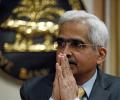
Reserve Bank Governor Shaktikanta Das on Friday said the rupee is holding up relatively well when compared to the currencies of emerging market peers and advanced economies. Days after the domestic currency breached the 80-level against the dollar, Das said Reserve Bank of India (RBI) has zero tolerance for volatile and bumpy movement in the rupee and added that the central bank actions have helped in smoother movement. He said RBI has been supplying US dollars to the market to ensure adequate supply of liquidity and also clarified that the central bank does not target a particular level for the currency.

After lagging behind other segments in the automotive (auto) space over the past few years, two-wheelers are expected to reverse their volume underperformance. After witnessing a 36.3 per cent volume decline over the 2018-19 (FY19) through 2021-22 (FY22) periods, the sector staged a recovery in 2022-23 (FY23), with volumes rising 17 per cent. While volumes are still a quarter lower than the FY19 peak of 21 million units, a double-digit growth trajectory is expected to prolong.

Besides high portfolio yield, investors may enjoy capital gains in debt funds in 2023 as bonds rally in anticipation of rate cuts.

The outbreak of the Omicron variant of the coronavirus and unprecedented lockdowns in China have roiled its equity market and also that of Hong Kong. After the crisis-hit Sri Lanka, China and Hong Kong are the worst-performing stock markets in Asia on a year-to-date basis.

'For our traditional membership base, it would be an access to disruptive ideas,' FICCI President Subhrakant Panda tells Asit Mishra/Business Standard.

BofA Securities has revised its year-end Nifty target from its earlier projection of 16,000 to 14,500 now - down over 6 per cent from the current levels. Fast tightening monetary conditions, slowing growth/fears of US recession and the likely Nifty EPS (earnings per share) cuts, BofA Securities said, are the key headwinds for the markets in the near-term. However, clarity on macro and monetary policy outlook in the US/India, it said, is the silver lining that could see markets bottom out by August/September 2022.

India's rupee is likely to remain under pressure due to high prices of crude oil and other commodities, and may stabilise at around 79-80 against the US dollar in the near term, say experts amid limited headroom available with the Reserve Bank to check the weakening of the domestic currency. The currency has slumped over 5 per cent this year after Russia's invasion of Ukraine sent international crude oil prices soaring to a decade high. On Monday, rupee ended at a fresh all-time low of 78.34 (provisional) against the US dollar.

A head of its meeting, the Reserve Bank of India (RBI) can take some solace from the softening food commodity prices. However, the events surrounding the last few weeks show that the fall may not be uniform across all commodities, and cereals like wheat and rice could be the outliers. A Reuters report said that local wheat prices jumped to a record Rs 23,547 per tonne on Wednesday. That is a 12 per cent rise from the recent lows that followed the government's surprise ban on exports on May 14.

'Overtightening of monetary policy by central banks and the spread of new Covid variants, which may force governments to restart lockdowns or restrict mobility.'
The Russia-Ukraine conflict, which has spooked financial markets globally, will set the tone for Dalal Street this week amid concerns over energy prices and foreign fund outflows, analysts said. Participants will also track key macroeconomic signals like GDP estimates and PMI data for manufacturing and services sectors to be announced this week, they added. "With earnings season behind us and given the overall sentiments, markets are expected to move in sync with global peers in the coming week. "A close eye will be kept on the developments concerning the Russia - Ukraine crisis and considering the inflation overhang, market participants will also observe movements in energy prices," said Shrikant Chouhan, Head of Equity Research (Retail), Kotak Securities Ltd.
